Restless Development’s Power Up Girls’ Education Initiative – backed by UK Aid Match – works to keep adolescent girls, particularly the most marginalised, in school and learning. Implemented across Bombali and Moyamba districts of Sierra Leone, it builds on Restless Development’s longer track record in girls’ education in the country, including the Leave No Girl Behind programme (2019-2023).
Since 2023, Power Up has reached 9,804 in-school girls and 4,440 out-of-school girls across 44 schools in 17 communities, all delivered through existing and cost-effective community governance structures in close collaboration with Sierra Leone’s Ministry of Basic and Senior Secondary Education (MBSSE). The model is built around five interlocking components:
Every girl deserves the opportunity to learn, grow, and shape her destiny, The progress we’ve seen in Moyamba and Bombali Districts is a testament to the transformative power of education and the strength of community partnerships. We are igniting potential and building brighter futures, one girl at a time.
Lesley Garura, Hub Director Restless Development Sierra Leone.
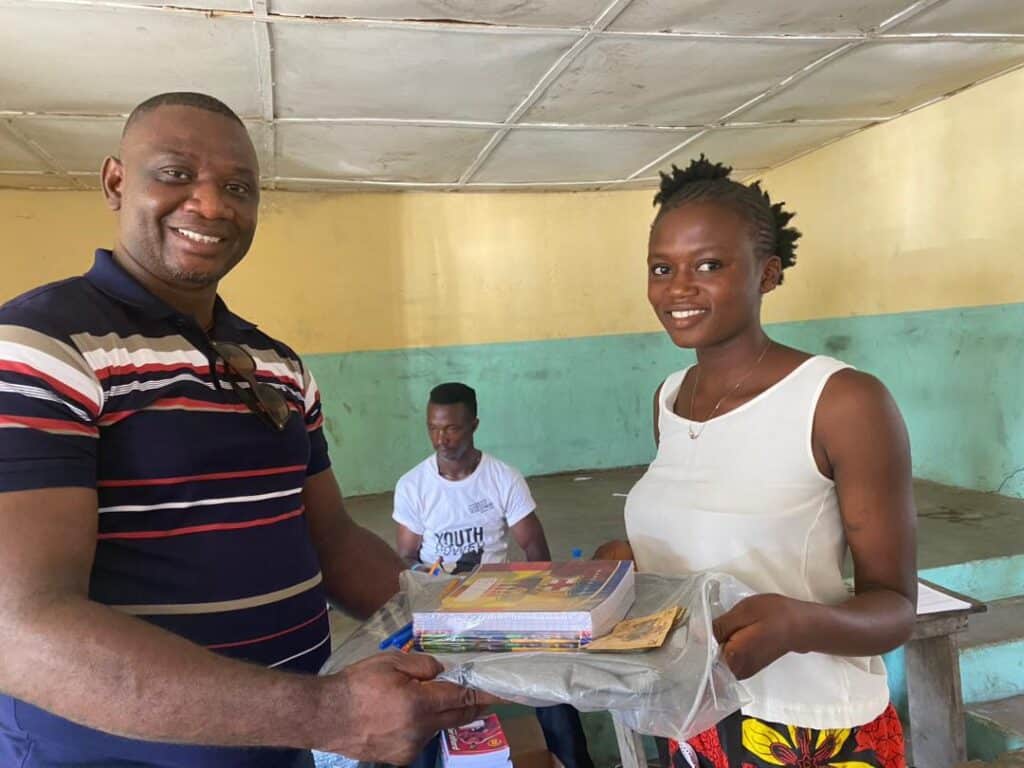
Senior Finance & Admin Manager, Mohamed Dainkeh presenting school startup package to an adolescent girl.
Key Achievements in Moyamba and Bombali Districts:
● Nurtured Growth in Safe Spaces:
The project established safe spaces led by trained female mentors, providing foundational literacy, numeracy, and crucial life skills for adolescent girls in and out of school, with 11,000 girls enrolled across 44 schools returning to formal education.
●Education Empowerment:
The project invested in educators by providing targeted training for 44 teachers, enhancing their skills in communication and participatory methods, and creating dynamic learning environments.
Through school assemblies and parental engagement sessions like Mothers’ and Fathers’ Club, dialogue meetings, and local radio broadcasts, we are championing girls’ right to education and safety. So far, 13,358 girls have clear plans for their futures and are equipped with career pathways that empower them for their next steps in education and employment.
●Advocated for Systemic Change:
The project actively engaged the Ministry (MBSSE) to ensure schools are recognised, teachers benefit from national training, participate in district-level coordination, and built alliances with fellow NGOs to scale collective impact.
Results from the Baseline to Endline Evaluations Include:
Girls willing to stay in school: 6% → 97.5%
Girls passing end-of-year exams: 42% → 99.4%
Girls involved in their own educational decisions: 38% → 88.8%
Boys with positive attitudes toward girls’ education: 44% → 100%
Girls with a personal transition plan: 31% → 92%
88.2% of girls credited the mentorship component specifically with helping them stay in school.
97.2% reported improved learning outcomes.
92.6% of girls expressed an aspiration to start a business.
The evaluation also documented significant community-level norm change, including the reintegration of lactating mothers into school, which all seven community stakeholders interviewed described as “previously unimaginable,” and a reduction in early marriages in programme communities. PTAs and SMCs, previously passive administrative bodies, are documented as having become active accountability mechanisms for girls’ education, reflecting an institutional shift with strong sustainability implications.