
Stakeholders from the private sector, industry associations, development organisations and the labour market came together in Kathmandu to validate findings from a Rapid Market Assessment on emerging digital employment opportunities for young people in Nepal.
The validation workshop, held on 6 August 2026 at Dhokaima Café in Patan Dhoka, was organised as part of the Creating Opportunities for Youth in the Digital Economy (CODE) project, a three-year initiative funded by the European Union and implemented by Swisscontact in consortium with Restless Development and the Robotics Association of Nepal.
The Rapid Market Assessment explored the skills and opportunities emerging within Nepal’s digital economy, with a particular focus on the experiences and needs of young people across Madhesh and Gandaki provinces. The assessment drew on responses from 45 employers, 12 key informant interviews and 14 focus group discussions involving 108 young people, adolescent girls and returnee migrants.
The validation workshop provided an opportunity for participants to engage directly with the evidence, share perspectives from their respective sectors and identify areas where the findings could be strengthened before the assessment was finalised.

Understanding where the opportunities are
One of the key findings discussed during the workshop was the continued demand for digital talent alongside challenges in finding candidates who are ready to enter the workplace. Nearly 69% of surveyed employers reported hiring digital talent in the previous year, while 58% said they faced difficulties finding candidates who were ready for real-world work.
The assessment identified software development and digital marketing as areas where employer demand, young people’s aspirations and considerations around inclusion intersect. Freelancing and mobile and device repair were also identified as potential routes for young people seeking to enter the digital economy.
At the same time, discussions highlighted the need to approach emerging technologies such as artificial intelligence, cloud computing, cybersecurity and data-related roles carefully. While employers expressed interest in these areas, many were unable to specify the skills required and current recruitment remained limited. The assessment therefore suggests introducing these areas as progression opportunities alongside more established digital occupations.
Designing opportunities around young people’s realities
The workshop also highlighted that young people across different parts of Nepal do not necessarily experience the digital economy in the same way.
The assessment identified differences between Madhesh and Gandaki, including greater emphasis on self-employment and micro-enterprise in Madhesh, alongside higher re-migration risks, while Gandaki was characterised by a deeper employer base and greater opportunities for wage and remote work.
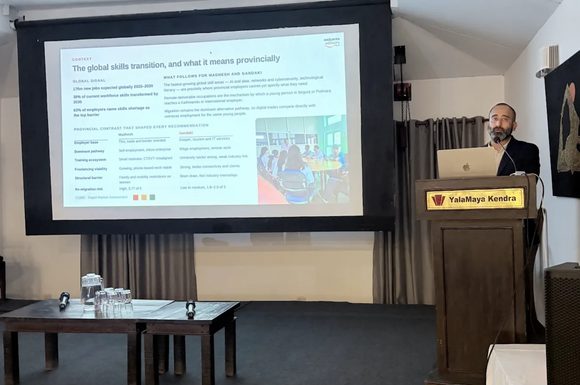
For Restless Development, ensuring that these differences are reflected in how digital skills programmes are delivered is an important part of creating meaningful pathways for young people. Inclusion also emerged as a key consideration in the assessment, with remote-capable work offering potential to address mobility barriers identified by women. The findings point to practical measures such as female trainers, local daytime delivery, device and data support, and recognition of prior learning for returnee migrants.
Participants also identified several areas requiring further attention, including strengthening employer trust through recognised certification, ensuring curricula are regularly updated with input from hiring employers, and incorporating practical experiences such as internships or capstone projects into priority courses.
The discussions further emphasised the importance of collaboration between the private sector, government and other stakeholders, as well as strengthening teachers’ digital capabilities and recognising skilled local employment as one of the pathways available to young people.
From evidence to action
The validation workshop marks an important step in moving the assessment from research towards action. Feedback from participants will be incorporated into the final Rapid Market Assessment report and trade prioritisation datasets.
The assessment is also informing a proposed tiered approach to digital skills training. The initial priorities include software development, digital marketing, freelancing, and mobile and device repair, while areas such as AI and machine learning, cybersecurity, telecom and ISP field technician roles, CCTV and security installation, and electric vehicles are being considered as emerging or specialised pathways. Data analytics and fintech are identified for continued monitoring and preparation as demand and accessibility develop.

For these pathways to translate into employment outcomes, the assessment highlights the importance of keeping curricula aligned with employer needs, connecting certification to recognised standards, embedding inclusion from the outset, and engaging local governments in the delivery of training and outreach.
Through CODE, Restless Development is contributing to this process by working with civil society organisations and communities to expand access to digital literacy, skills and opportunities for young people, particularly those who may face barriers to participating in Nepal’s growing digital economy.
The conversations and evidence generated through the Rapid Market Assessment will help shape the next phase of the CODE project as partners work towards creating practical pathways for young people to build skills, access employment and participate in Nepal’s digital economy.

