
Climate change can often feel like a problem too large and distant for a school to tackle. But for young people, the effects of environmental degradation are already part of everyday life, from increasing waste and plastic pollution to changing weather patterns and pressure on the natural resources their communities depend on. A climate-smart school offers one way to make these issues more tangible. It is a school where students are encouraged not only to learn about climate change and environmental sustainability, but also to understand the challenges around them and take practical action.
That is the idea behind the Climate Smart Schools initiative under the European Union funded GreenShift Nepal project. In its third year, 12 schools from Khadak Municipality in Saptari, Ichchakamana Rural Municipality in Chitwan, and Tilottama Municipality in Rupandehi were selected to participate. Four schools from each municipality joined the initiative, receiving support to integrate climate education, sustainable waste management and circular economy practices into school life.
The 12 schools were Shree Shanti Model Secondary School, Shree Shankarnagar Durgadatta Secondary School, Shree Janajyoti Secondary School and Shree Bhulke Secondary School from Tilottama Municipality; Shree Rastriya Secondary School Hattibang, Shree Sravashanti Secondary School, Shree Triveni Baraha Secondary School and Shree Ranikhola Secondary School from Ichchakamana Rural Municipality; and Shree Rajaji Tulshilal Jonche Janata Secondary School, Shree Janata Secondary School Pansera, Shree Bhawani Prasad Sakal Prasad Ram Prasad Janata Secondary School and Shree Janata Secondary School Bhairoganj Belha from Khadak Municipality.
What emerged over the course of the initiative was not one uniform model of a climate-smart school. Each school responded to its own circumstances. Some focused on waste management and reducing plastic use. Others used plantation and gardening to engage students with their environment. Several took students outside the classroom to see how waste is collected, processed and disposed of. Many used Eco Clubs to organise activities and bring environmental messages to the wider community.
Together, their experiences show how climate education can become more meaningful when students are given opportunities to act on what they learn.
Making waste something students could understand
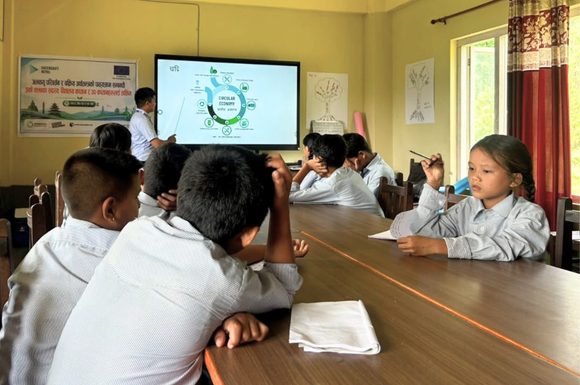
One of the common areas of work across the schools was the circular economy, an approach that encourages resources to be used for as long as possible and waste to be reduced, reused and recycled rather than simply discarded.
For students, understanding that idea often began with seeing the waste system for themselves.
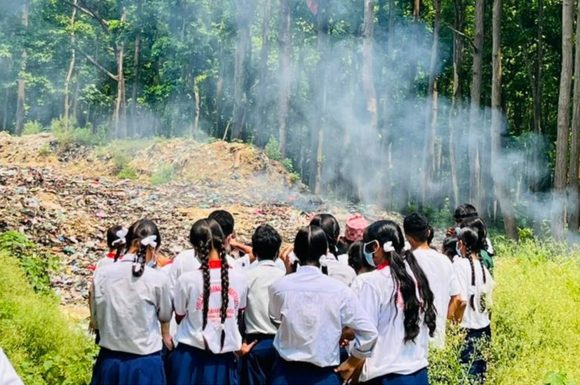
At Shree Janajyoti Secondary School, Tilottama Municipality, Eco Club leaders received an orientation on the circular economy before visiting a landfill site. At Shree Shankarnagar Durgadatta Secondary School, Tilottama Municipality, Eco Club members similarly received training on climate change and the circular economy and visited waste management sites. Shree Bhulke Secondary School, Tilottama Municipality organised a field visit to a waste processing and knowledge centre, where students observed waste collection, segregation, processing and recycling.
The exposure visits gave students something that a classroom session alone could not: a direct view of what happens to the waste generated by households and schools.
The learning then began to influence what happened within the schools themselves.
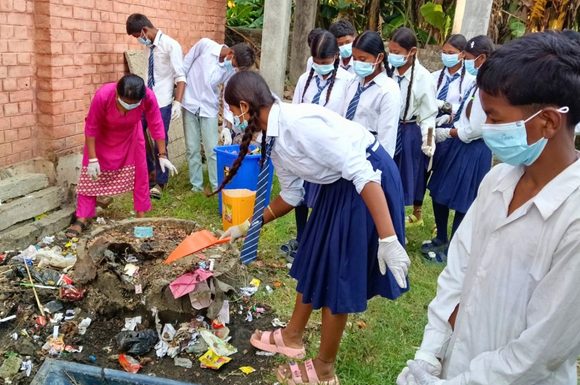
At Shree Triveni Baraha Secondary School, Ichchakamana Rural Municipality, waste segregation bins were installed and Eco Club members took on the responsibility of monitoring junk food. Shree Bhulke Secondary School, Tilottama Municipality also introduced waste segregation bins, while Shree Rastriya Secondary School Hattibang, Ichchakamana Rural Municipality distributed dustbins and plants to students.
At Shree Shankarnagar Durgadatta Secondary School, Tilottama Municipality, the school went a step further by replacing plastic bottles with stainless steel jugs and glasses. Shree Bhawani Prasad Sakal Prasad Ram Prasad Janata Secondary School, Khadak Municipality made a similar shift, introducing reusable stainless steel jugs and glasses as well as a water filter and waste segregation bins.
These changes were modest, but they gave students practical ways to apply the environmental lessons they were receiving.
Turning school grounds into places for climate action
Plantation and gardening provided another practical entry point.
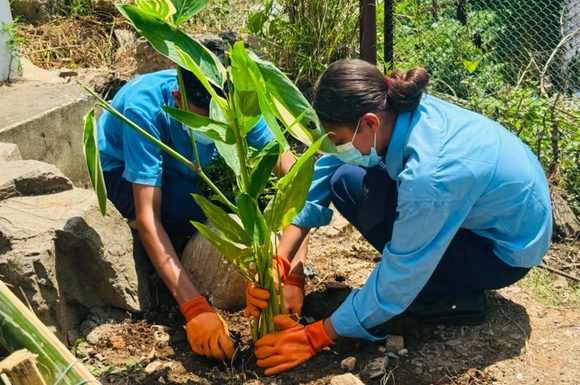
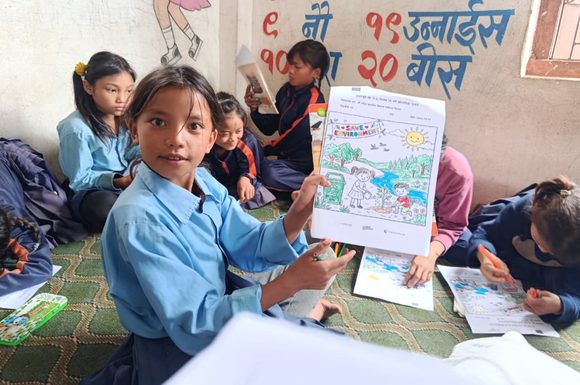
Across the three municipalities, schools used their own grounds and surrounding areas to give students opportunities to take part in environmental activities. At Shree Janajyoti Secondary School, Tilottama Municipality, plantation was combined with a street clean-up in which students collected five kilograms of waste. Shree Shanti Model Secondary School, Tilottama Municipality combined plantation and clean-up activities with an environmental drawing competition. Shree Ranikhola Secondary School, Ichchakamana Rural Municipality also carried out plantation activities alongside its other climate-related work.
At Shree Bhulke Secondary School, Tilottama Municipality, students and teachers participated together in plantation and garden strengthening. The involvement of teachers was important because it positioned environmental action as something shared across the school community rather than an activity limited to the Eco Club.
For some schools, however, the environmental context extended beyond the school compound.
At Shree Rastriya Secondary School Hattibang, Ichchakamana Rural Municipality, Principal Lok Bahadur Magar connected environmental education with the realities of the community around the school. Agriculture, particularly maize farming, is an important part of local livelihoods, and the school saw potential in helping students think about how local resources could support more sustainable livelihoods. Fruit plantation was one of the ideas encouraged by the school.
“Children should be aware of this from their young age,” Magar said.
His perspective illustrates why climate-smart education can mean different things in different places. In an agricultural community, climate awareness is closely connected to land, natural resources and livelihoods. Helping students understand those connections can be as important as teaching them about global climate change.
When students took the message outside
The schools also found ways to turn environmental awareness into public action.
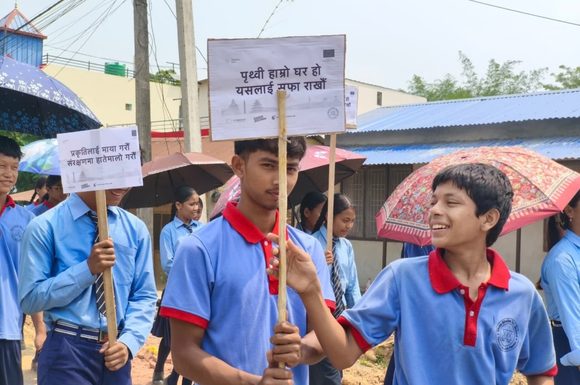
At Shree Bhulke Secondary School, Tilottama Municipality, students and teachers organised an awareness rally during World Environment Day. Carrying placards and chanting messages about protecting the environment and reducing plastic use, the students took their campaign through the surrounding community.
The school subsequently reported changes in students’ behaviour. Students became more conscious about using designated waste bins, the school observed a reduction in single-use plastic use and more students became interested in joining the Eco Club. Teachers also began incorporating environmental themes more regularly into classroom discussions.
The school reported that the influence extended into homes as well. Parents observed their children practising waste segregation and reducing plastic use, while community members who witnessed the rally expressed appreciation for the students’ efforts.
Similar efforts took place elsewhere. Shree Shankarnagar Durgadatta Secondary School, Tilottama Municipality organised an environmental rally using banners and placards, while schools in Khadak Municipality combined awareness activities with plantation, clean-up programmes, quizzes and other community-facing events.
These activities gave students a role that went beyond being recipients of environmental information. They became people who could communicate that information to others.
Eco Clubs at the centre of the change
Much of this work was driven by the schools’ Eco Clubs.
The clubs provided students with an organised space to discuss environmental issues, plan activities and take responsibility for putting ideas into practice. At Shree Ranikhola Secondary School, Ichchakamana Rural Municipality, 22 Eco Club members participated in circular economy training. At Shree Triveni Baraha Secondary School, Ichchakamana Rural Municipality, the Eco Club was involved in waste segregation and monitoring junk food. At Shree Rastriya Secondary School Hattibang, Ichchakamana Rural Municipality, World Environment Day activities reached 159 Eco Club members.
In Khadak Municipality, the four Climate Smart Schools also used Eco Clubs to build participation within their school communities.
At Shree Janata Secondary School Bhairoganj Belha, Khadak Municipality, the school first formed its Eco Club and oriented its management committee before involving parents in plantation and environmental quiz activities. Shree Janata Secondary School Pansera, Khadak Municipality combined environmental awareness with plantation, clean-up activities, plastic reduction and an environmental quiz. Shree Bhawani Prasad Sakal Prasad Ram Prasad Janata Secondary School, Khadak Municipality brought together training, plantation, clean-up, an awareness rally, environmental competitions and practical changes such as reducing plastic bottles.
Meanwhile, Shree Rajaji Tulshilal Jonche Janata Secondary School, Khadak Municipality engaged its Eco Club through circular economy orientation and environmental activities, while the schools in Ichchakamana Rural Municipality combined classroom learning with exposure visits, plantation and community awareness.
The result was that environmental action became something students could participate in rather than simply something adults talked about.
Change that reaches beyond a single activity
It would be easy to measure the Climate Smart Schools initiative through the number of orientations conducted, students reached, trees planted or clean-up activities organised. Those figures matter, but they do not tell the whole story.
The more significant change lies in what happened around those activities.
Students at Shree Bhulke Secondary School, Tilottama Municipality began paying greater attention to waste disposal and plastic use. At Shree Janajyoti Secondary School, Tilottama Municipality, students were able to connect classroom learning with the realities of a landfill. At Shree Shankarnagar Durgadatta Secondary School, Tilottama Municipality, the school changed some of its own practices by replacing plastic bottles with reusable alternatives. At Shree Rastriya Secondary School Hattibang, Ichchakamana Rural Municipality, environmental learning was connected to local agriculture and future livelihoods. At Shree Janata Secondary School Bhairoganj Belha, Khadak Municipality, parents became part of the school’s environmental activities.
The schools also created opportunities for young people to practise leadership. They organised rallies, participated in competitions, led clean-ups, visited waste facilities and worked through their Eco Clubs. In doing so, environmental education became connected with communication, teamwork and community participation.
This was particularly important because the schools were operating in very different contexts. Tilottama Municipality has existing municipal efforts around waste segregation and environmental awareness. In Ichchakamana Rural Municipality, some schools face more limited access to formal waste collection, making plastic waste a more difficult challenge. In Hattibang, environmental concerns are closely tied to agriculture and local livelihoods. The schools therefore had to adapt their climate action to the realities around them.
A foundation for what comes next
The 12 Climate Smart Schools have not solved the environmental challenges facing their communities, nor was that the expectation.
What they have done is create a starting point.
They have helped students understand the connections between waste, consumption, natural resources and climate change. They have given Eco Clubs a practical role within school life. They have encouraged teachers and parents to participate. And in several cases, they have shown that what students learn at school can influence behaviour beyond the school gates.
Across Khadak Municipality, Ichchakamana Rural Municipality and Tilottama Municipality, the 12 schools have each taken their own route towards becoming more climate smart. Some changed how they handled waste. Some reduced plastic. Some planted and maintained gardens. Some took students to see waste management systems first-hand. Some brought parents and communities into environmental activities. All created spaces for young people to participate.
The significance of the initiative lies in that combination of learning and action. When students are given the opportunity to understand an environmental problem and then participate in addressing it, climate education becomes something they can experience in their everyday lives.
And that is what these 12 schools have been building through GreenShift Year 3: not simply awareness about climate change, but a generation of students who are beginning to see themselves as part of the response.

