
When Boys Union Club received a Youth Advocacy Grant under the EU funded GreenShift Nepal project, environmental advocacy was a new territory for a group whose experience had largely been rooted in sports. In Ichchhakamana Rural Municipality, its members are now using that experience of teamwork and mobilisation to get young people thinking about waste, plastic and the circular economy.
In Ichchhakamana Rural Municipality, environmental action comes with its own set of challenges. Waste collection does not reach all communities, plastic waste is difficult to manage, and young people frequently leave the municipality in search of employment. For a youth organisation, this makes mobilisation particularly difficult. It also makes the question of who will take responsibility for local environmental issues an important one.
Boys Union Club was already accustomed to bringing young people together, but mostly through sports. GreenShift offered the club an opportunity to take that organising experience into a new area. As one of three youth groups selected for the Youth Advocacy Grant, the club received support to lead local activities around circular economy, waste management and environmental awareness.
For Rabi Khamcha, a member of Boys Union Club, the connection between the club’s existing work and its new environmental role became clear quite quickly.
We already knew how to work as a team. What we had not done before was use that teamwork for an environmental issue. GreenShift gave us the opportunity to learn something completely new and then take that learning to other young people.
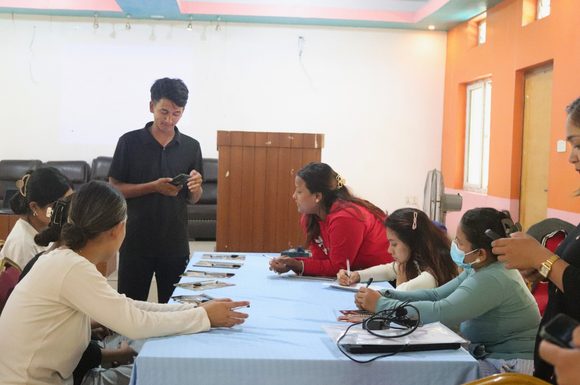
The first step was learning themselves. In May, 20 local young volunteers joined Boys Union for an orientation on circular economy and the TagMe application. It was the club’s first time organising an activity of this kind and leading a conversation centred on an environmental agenda. With technical and facilitation support from Restless Development and Youth Innovation Lab, the volunteers explored waste management, circular economy and digital waste mapping.
That first experience gave the group a foundation to begin working more independently. A few months later, the club was no longer talking only to its own volunteers. It was taking the discussion into schools.
Taking a new conversation to young people
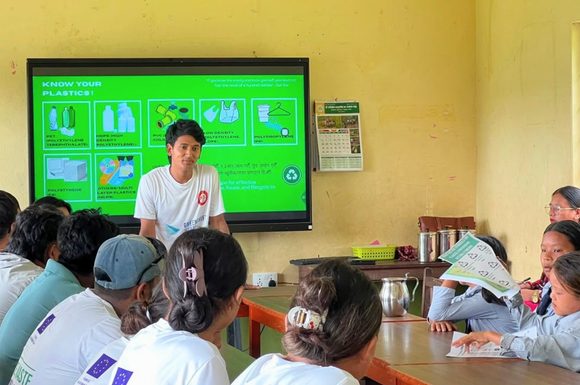
On 10 July, Boys Union organised an awareness and interaction programme for Grade 11 and 12 students at Sarva Shanti Secondary School in Kurintar. Fifty three people took part. Students learned about different types of plastic, waste management, circular economy, their own roles and responsibilities in managing waste, and how the TagMe application can be used to document waste.
The activity was designed as a conversation rather than simply a lecture. After the presentation, students took part in questions and discussion, asking about waste management and the practical application of what they had learned. The group’s subsequent assessment recorded several changes among participants: students demonstrated a clearer understanding of waste management and circular economy, understood the purpose and use of TagMe, showed greater interest and participation in environmental protection, and expressed a commitment to keeping their school clean and green.
For Rabi, that response was significant because it showed the young volunteers that awareness could lead to something more than simply knowing new information.
The most encouraging part was seeing students connect the discussion to their own school. They were not only asking what circular economy means. They were asking what they can actually do with the waste around them.
The conversation continued at Shree Rani Khola Secondary School on 29 July, where another 46 participants took part in an awareness programme on circular economy. The students were introduced to waste management and the different types of plastic, continuing the club’s effort to make environmental issues part of everyday conversations among young people.
Finding environmental leadership in familiar strengths
What makes Boys Union’s experience distinctive is that the club did not have to start from scratch as a youth organisation. It already had relationships, volunteers and experience in organising people. What changed was where those strengths were being applied.
Project staff described the club’s GreenShift experience as unique precisely because its background was in core sports. Mobilising local young volunteers, coordinating with stakeholders, managing events, reporting and documenting activities were all new experiences for the team, as was introducing circular economy as a subject for discussion within the club and the wider community.
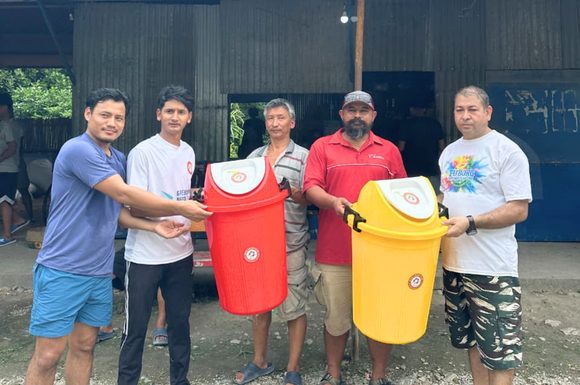
The club also began reaching beyond schools. As part of its grant activities, Boys Union conducted community awareness on circular economy with stakeholders from the hotel sector, opening up a conversation about how businesses connected to tourism and hospitality can think about waste and resource use.
For a municipality where tourism and movement of people can add pressure to local waste systems, that broader engagement matters. It also marked another step in the club’s own development: young volunteers were learning to engage not only with their peers, but also with community and business stakeholders.
At first, we thought our role would mainly be to create awareness among young people. As we started working, we understood that waste is connected to everyone. Schools, businesses, families and local government all have a role.
Rabi
What changes when young people take the lead
The numbers tell part of the story. Twenty young volunteers took part in the club’s first orientation. Fifty three students joined the programme at Sarva Shanti Secondary School, followed by another 46 at Shree Rani Khola Secondary School.
But the more interesting changes are found in what those participants did with the conversation. At Sarva Shanti, students moved from learning about waste management and TagMe to expressing greater interest in environmental protection and a commitment to keeping their school clean and green. The collaboration between the school and Boys Union also became stronger through the activity.
For Boys Union itself, the shift is equally important. The club entered GreenShift with environmental advocacy as an unfamiliar area. It is leaving with young members who have experience facilitating discussions, working with schools and stakeholders, communicating an environmental message and thinking about waste as a community issue.
Rabi sees that as something the club can carry forward.
We have learned that youth leadership does not have to stay within one area. We can bring the same energy we use for sports into other issues that matter to our community. The important thing is that young people are given the chance to lead.
In Ichchhakamana, that chance has allowed Boys Union to add a new dimension to its identity. The club is still a place where young people come together, but its idea of what they can come together to do has expanded.
For a community where many young people eventually leave in search of opportunities elsewhere, creating reasons for those who remain to participate, organise and take responsibility locally is significant. Boys Union’s GreenShift journey has started with waste and circular economy, but it has also been a journey in youth leadership itself.
The club came into the project knowing how to build a team.
It has spent the past few months learning what that team can do for its community.

