
In Tilottama, Lumbini Province, the Rotaract Club of Central Rupandehi is showing what happens when young people are trusted with the resources, skills and space to lead environmental action.
On an August morning, seven teams of young people set out across the streets of Butwal with a simple challenge: collect as much plastic waste as possible in three hours.
There was a competitive element. There were prizes. There were teams racing along a designated route.
But underneath the competition was a more serious message: plastic waste is not an abstract environmental problem. It is sitting in our streets, markets and neighbourhoods, and young people can do something about it.
By 10 a.m., the teams had collected 387 kilograms of plastic waste.
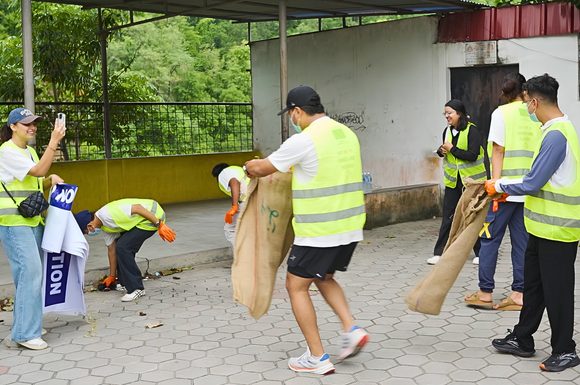
The Trash Collection Competition was one of several activities led by the Rotaract Club of Central Rupandehi (RAC) through the EU funded GreenShift Nepal project. Supported through GreenShift’s Youth Advocacy Grant, the club used the opportunity not simply to run environmental events, but to experiment with different ways of getting young people, communities, schools, businesses and local government involved in tackling plastic waste.
The result was a project that moved between awareness, action, skills, data and advocacy, and demonstrated the power of youth led solutions.
Young people taking the lead
The Rotaract Club of Central Rupandehi (RAC) is based in Tilottama Municipality and has been active in community and youth leadership.
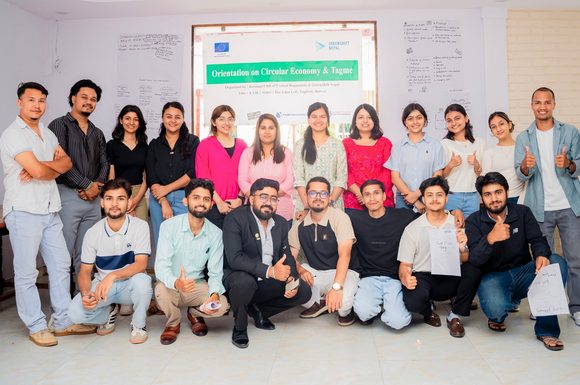
Through GreenShift, the club received a grant of NPR 200,000 to develop and implement its own environmental action. From the beginning, the project placed young people in leadership roles, with RAC members taking responsibility for planning, coordination, volunteer mobilisation, implementation and documentation.
The first step was to make sure the young volunteers themselves had the knowledge and tools to lead.
In May, 20 volunteers from the RAC and Interact Club of Central Butwal participated in an orientation on circular economy, environmental and social safeguarding, plastic management, photography and the TagMe application. The training combined discussion with practical field exercises, including collecting waste related data using TagMe.
The intention was clear: young people would not simply be participants in someone else’s environmental programme. They would have the knowledge and skills to shape and deliver their own.
Turning awareness into action
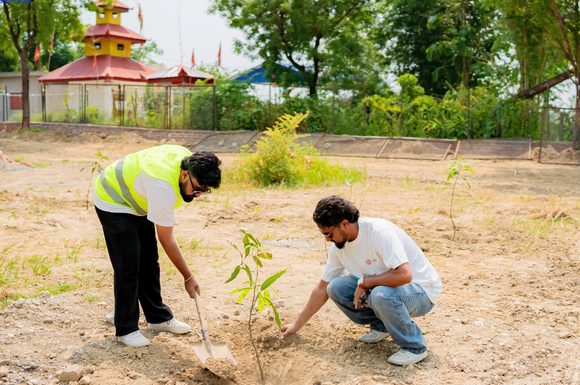
On World Environment Day, more than 300 people gathered at Tilottama Park for an environmental awareness programme jointly organised by RAC with Tilottama Municipality and the Tilottama Park Committee.
The day combined tree planting, an environmental information stall and street theatre.
In just five minutes, more than 700 saplings were planted. The activity brought together elected representatives, government officials, students, young people and community members, creating a visible demonstration of collective responsibility for the local environment.
But the young people also understood that environmental action is not only about planting trees.
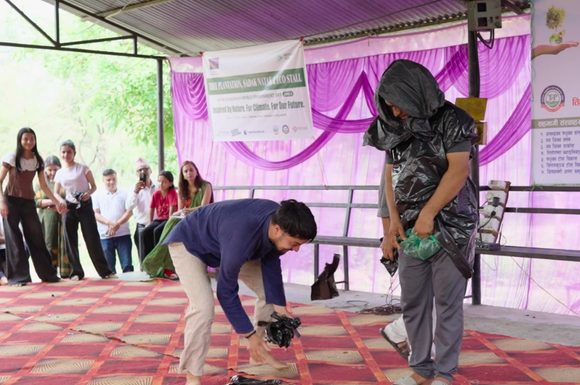
Through a street drama, audiences were invited to think about the everyday realities of plastic pollution, from single use plastics and irresponsible disposal to blocked drainage and water pollution.
More than 300 people watched the performance, which used humour, storytelling and familiar situations to make environmental issues accessible. Audience members subsequently discussed the issues raised and received information about the TagMe campaign.
The message was simple: environmental change starts with what people do every day.
From plastic waste to possibility
At Shanti Namuna Secondary School, more than 65 students took part in a hands on plastic reuse training programme built around the theme “Transforming Plastic Waste into Sustainable Opportunities.”
Instead of simply being told about recycling, students learned by making.
They learned how to combine plastic and agricultural materials to make sitting mats. They experimented with traditional basket weaving using recycled plastic strips. They learned to make decorative garlands from plastic and fibre bags.
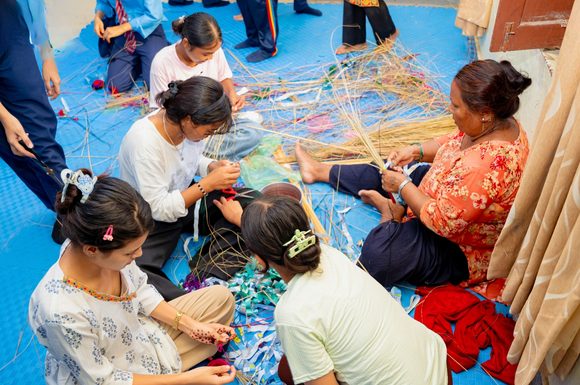
The training deliberately connected environmental sustainability with existing skills and cultural practices. Traditional Nepali craft techniques became a way of imagining new uses for materials that might otherwise be thrown away.
The young participants were then encouraged to pass on what they had learned to classmates and family members.
That created a multiplier effect: instead of 65 young people being the end point of the activity, they became potential environmental educators within their own communities.
For RAC, this was also about changing the way young people think about waste, not simply as something to dispose of, but as something that can be reused, transformed and potentially create economic opportunities.
Making the problem visible through data
One of the most important parts of the project happened away from the stage.
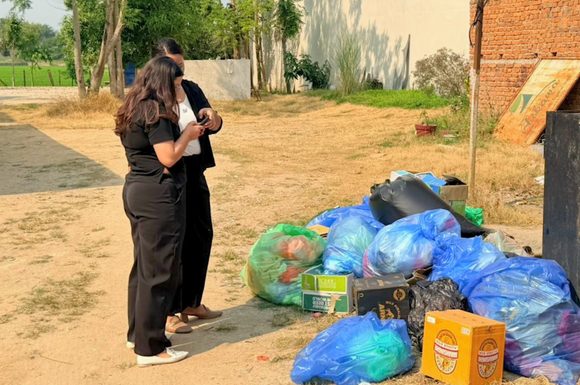
Young volunteers took the TagMe application into the field to document waste related information.
The club eventually collected 609 waste data records, creating a digital record of waste locations and giving young people practical experience in field observation, data collection, digital reporting and environmental documentation.
And the process did not go exactly according to the original plan.
The team had initially intended to conduct the waste collection competition and TagMe activities in Tilottama. But during their assessment, they found that there was not enough visible waste in the targeted areas to make the activities meaningful.
Rather than carrying out an activity simply because it had been planned, the young team adapted. In coordination with the project team, they shifted the activities to Butwal, where they could identify suitable waste locations and generate more useful results.
That decision captures an important part of what youth leadership can look like: having the confidence to change course when the evidence tells you that something is not working.
Bringing different voices to the same table
In July, more than 100 people, including students, teachers, government representatives, industry representatives and waste management actors, came together at Shanti Namuna Secondary School for a dialogue on plastic reduction, reuse and recycling organized by RAC.
The panel brought different perspectives into one room: a waste management expert, an industry representative and a local government official.
Together, they discussed the challenges of plastic management, including microplastics, consumer behaviour, recycling, producer responsibility and the role of government regulation.
The discussion also generated possible solutions, including stronger municipal regulations, greater environmental awareness among children and increased use of recycled materials in production.
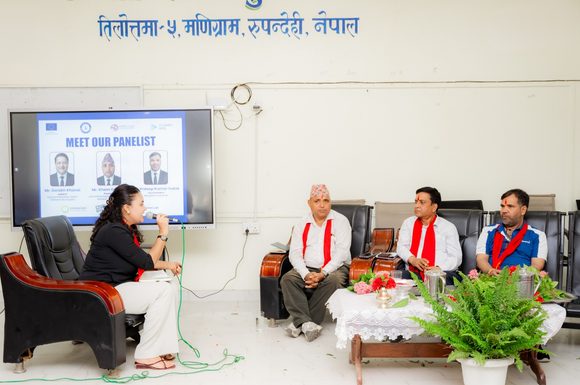
For the young organisers, this was an opportunity to do more than raise awareness. They created a space where young people could engage with the people who make, regulate, manage and live with the consequences of plastic waste.
Students and teachers who participated were encouraged to share what they learned with classmates and parents, extending the conversation beyond the event itself.
When youth power becomes collective power
The Trash Collection Competition brought the different strands of the project together.
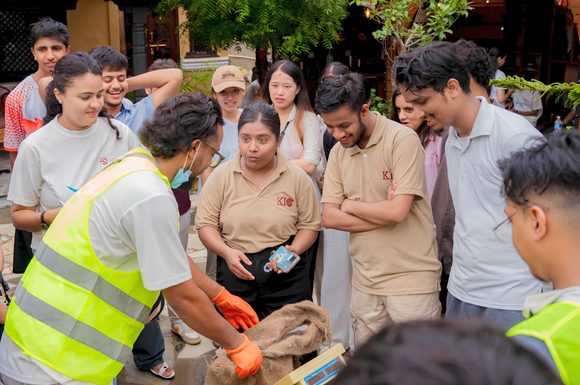
Seven youth organisations participated in the three hour challenge, competing to collect the largest quantity of plastic waste along a designated route.
RAC mobilised seven volunteers to manage logistics, provide collection sacks, masks, gloves and water, guide teams and coordinate with traffic police to support safe movement along the route.
The collected plastic was weighed transparently at the end of the competition.
The final figure, 387 kilograms, was more than a competition result. It made the scale of plastic waste visible while demonstrating what organised youth action could achieve in just three hours. The waste was subsequently transported for proper disposal.
And perhaps just as importantly, the activity connected seven youth organisations around a shared environmental goal.
RAC’s approach was therefore not about young people acting alone. It was about young people creating opportunities for others to act with them.
From a grant to a platform for leadership
“GreenShift strengthened our relationship with the local government. The government has now started expressing interest in continuing our collaboration on plastic reduction, waste management, the circular economy, and youth-led advocacy. For us, this represents a significant shift.” says Rtr. Bijay Adhikari, President of the Rotaract Club of Central Rupandehi.
The project may have started with a grant, but its most important outcome was not a single event or even a single number.
It was the experience of young people seeing a problem, developing the skills to understand it, testing different solutions, bringing others together, adapting when circumstances changed, and making their voices heard by decision makers.
From 609 pieces of data to 387 kilograms of collected plastic, from 700 plus saplings planted in five minutes to more than 65 students learning how waste can be transformed, the Rotaract Club of Central Rupandehi demonstrated that youth participation is not an add on to environmental action.
It can be the force that drives it.
And in Rupandehi, young people are showing what that force can look like.

