
For Khadak Nagar Yuwa Sanjal, environmental advocacy began with learning about waste. It soon became a much bigger effort to bring young people, community members and local stakeholders into the same conversation about how Khadak can manage its environment differently.
In Khadak Municipality, waste is a problem people encounter in ordinary places: along roads, around markets, in public spaces and near schools. For young people living in the municipality, it is difficult to separate environmental concerns from everyday life.
Khadak Nagar Yuwa Sanjal was one of the youth organisations selected to receive a Youth Advocacy Grant under the EU funded GreenShift Nepal project. The grant gave the group an opportunity to turn its interest in community service into a more focused programme of environmental action, beginning with the young people who would lead it.
In May, 32 local young people participated in an orientation on circular economy and the TagMe application. They learned about waste management, plastic reduction, reuse and recycling, while also gaining practical knowledge about using digital tools to identify and document waste. The young volunteers were then expected to support the group’s wider campaign, giving the training a purpose beyond the session itself.
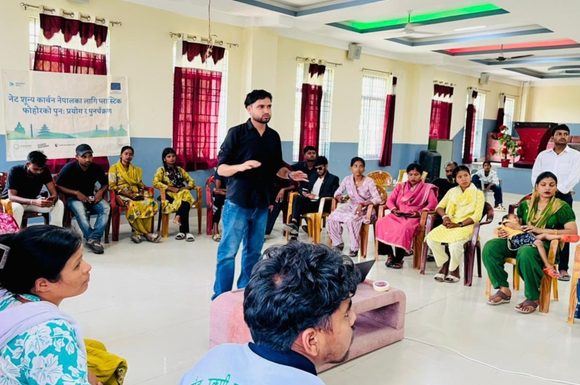
For Rakiraj Prabhat Chaudhary, Chairperson of Khadak Nagar Yuwa Sanjal, the training helped the group see environmental advocacy as something that required more than awareness.
We already knew that waste was a problem in our community. What GreenShift helped us understand was how we could organise ourselves around that problem. We wanted our young volunteers to learn first, but we also wanted them to take that learning back into the community.
That is exactly what began to happen.
From learning to action
The first major step was a community clean-up.
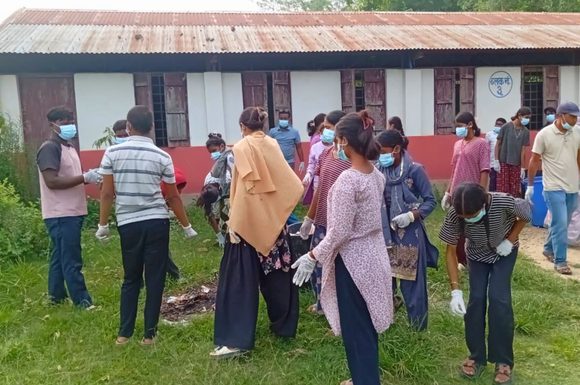
Fifty six people participated as young volunteers, local citizens and representatives from different organisations came together to clean roads, public spaces, school premises and market areas. The group also used the activity to talk with community members about waste management and reducing plastic waste.
The organisers divided participants into groups, provided them with cleaning materials and worked across different parts of the municipality. The activity was practical, but the young people were also using it as an opportunity to start conversations with residents.
For Rakiraj, that combination mattered.
When you clean a place, people can immediately see the result. But we wanted the conversations to continue after the clean-up. We wanted people to think about where the waste comes from, what they can reduce and what they can do with the waste they already produce.
That distinction became important to the group’s approach. The clean-up addressed what was already visible, while the awareness component tried to address the behaviour and habits behind it.
The activity also brought together people who might not normally work alongside one another. Youth volunteers, local residents and representatives of different organisations participated in the same effort, giving the young organisers an opportunity to practise coordination and community mobilisation.
Making space for a bigger conversation
The group’s work did not stop at the community level.
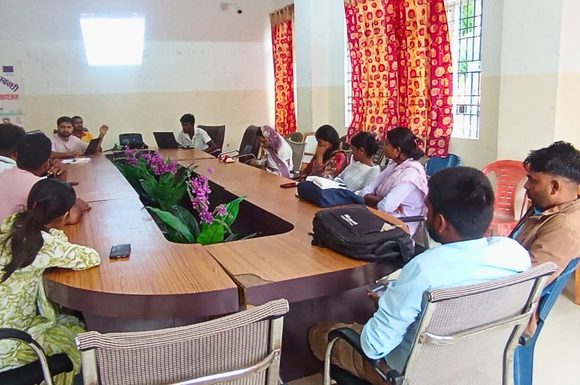
On 23 July, Khadak Nagar Yuwa Sanjal worked with Khadak Municipality to organise an awareness activity at the municipal meeting hall, bringing together 15 local stakeholders.
That represented a shift in the group’s role.
Young people who had begun by learning about circular economy were now helping convene a conversation involving local stakeholders and the municipality. The issue was no longer simply how to collect waste from a particular street. It was about how different parts of the community could contribute to reducing, managing and responding to waste.
Rakiraj says the experience changed how he understood youth advocacy.
We realised that advocacy is not only about speaking for young people. It is also about creating a space where young people can bring people together and have a discussion about a problem that affects everyone.
That experience was part of the group’s own growth. Project staff noted that the youth group had the opportunity to facilitate orientations for its local volunteers, helping improve its facilitation abilities while strengthening its understanding of the campaign.
The young people were therefore not simply recipients of training. They were becoming facilitators themselves.
The numbers show the growth, but not all of the change
The progression is visible in the numbers.
The group’s first orientation reached 32 local young people. Its clean-up brought together 56 participants, extending participation beyond the original group of volunteers. Later, 15 local stakeholders joined the municipality level awareness activity.
Those numbers show the expanding reach of the work, but the group’s impact also lies in the different kinds of participation it created.
Young people learned to facilitate.
Community members joined a collective clean-up.
Residents were engaged in conversations about waste management and plastic reduction.
And the youth network created a space for local stakeholders to discuss the issue together.
The project’s broader quarterly reporting also recorded that the youth group had strengthened its facilitation abilities through leading orientations for its local volunteers.
For Rakiraj, that development is one of the most lasting parts of the experience.
The biggest change for us is confidence. We started with young people who wanted to do something for the community. Through the project, we learned how to organise that interest, how to communicate with different people and how to take an idea from a discussion into an activity.
What young people can build together
Khadak’s environmental challenges will not disappear because of a clean-up or a few awareness sessions. But the young people involved in the project have gained something that can continue to be used after the grant period ends: experience in organising, facilitating, communicating and working with people outside their own networks.
That matters because environmental change depends on more than individual awareness. It requires people to work together, and youth organisations can play a role in making that happen.
For Khadak Nagar Yuwa Sanjal, the Youth Advocacy Grant provided the resources and opportunity to test that role. The group began by learning about circular economy and TagMe. It moved into community action, and then into conversations with local stakeholders.
Rakiraj believes the next step is to keep that momentum within the community.
We want young people to understand that they do not have to wait until they are older to contribute. They can start with the problems they see around them, learn about them and bring other people into the solution.
That may be the most important part of Khadak Nagar Yuwa Sanjal’s GreenShift journey. The group did not set out to solve Khadak’s entire waste problem. Instead, it created opportunities for young people to understand the issue, act on it and bring others into the work.
The clean-up made the problem visible.
The training gave young people tools to understand it.
And the conversations with the wider community created a space to think about what happens next.
For the young people of Khadak, that is where environmental advocacy has begun: not with having all the answers, but with being willing to organise around the questions that matter to their community.

